164. Lead Vehicle Driving Backward evaluation scenario
In the lead_vehicle_driving_backward evaluation scenario, the vehicle_actor drives in reverse (backwards) ahead of the Ego in the same lane.
Scenario location: $FTX/logiq/scenario_library_post_match/lead_vehicle/lead_vehicle_driving_backward
164.1 Actors
The actors associated with this scenario are as follows:
| Actor | Description | Type | Depiction |
|---|---|---|---|
ego |
Vehicle under test | vehicle |
 |
vehicle_actor |
Lead vehicle | vehicle |
 |
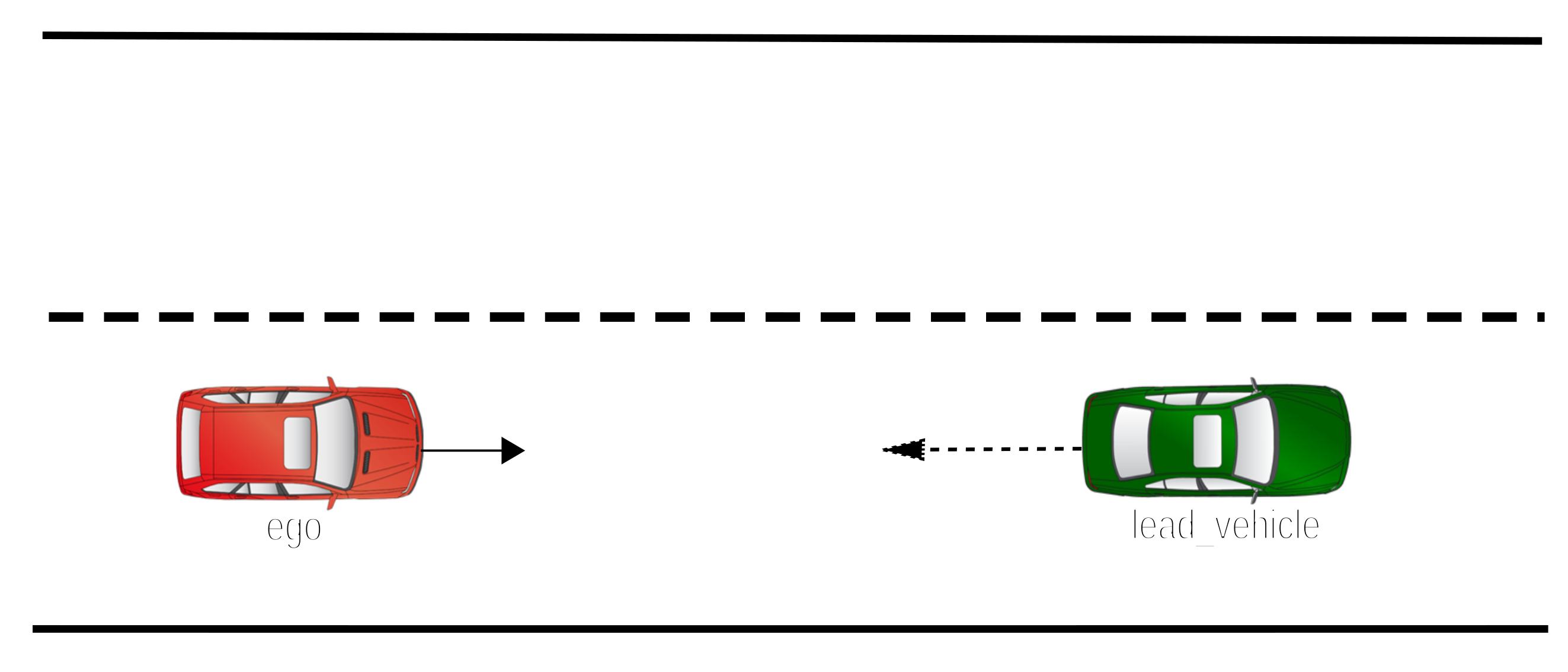
164.2 Scenario phases
The phase descriptions are as follows:
164.2.1 lead_vehicle_driving_backward
Ego: The Ego drives behind the vehicle_actor in the same lane and stays in a driving lane for the entire scenario.
vehicle_actor: The vehicle_actor drives in reverse (backwards) ahead of the Ego in the same lane, with a speed in the
range between min_speed and max_speed, and stays in a driving lane for the entire scenario.
164.3 Configuration parameters
Use these parameters to constrain the scenario. If you do not set a specific value, the default value will be used.
| Parameter | Type | Unit | Description | Default value |
|---|---|---|---|---|
min_speed |
speed | kph | Minimum speed of the vehicle_actor | -30kph |
max_speed |
speed | kph | Maximum speed of the vehicle_actor | -3kph |
same_road_limit |
time | s | Time threshold for the vehicle_actor to be considered as driving on the same road as the Ego | 10s |
min_scenario_duration |
time | s | Minimum time of the entire scenario | 0.5s |
[Click] The input items inherited from the sut.logiq_base_vehicle_scenario scenario are as follows:
| Parameter | Type | Unit | Description | Default value |
|---|---|---|---|---|
kinds |
list of evaluation_object_kind | — | Possible kinds of vehicle_actor in the scenario | — |
164.4 Metrics
164.4.1 Coverage
[Click] The coverage items inherited from the sut.logiq_base_vehicle_scenario scenario are as follows:
| Item | Description | Values | Unit/Type |
|---|---|---|---|
vehicle_speed_at_start |
Agent speed at start of the scenario | [0..150), every: 10.0 | mph |
[Click] The coverage items inherited from the sut.logiq_base_scenario scenario are as follows:
| Item | Description | Values | Unit/Type |
|---|---|---|---|
ego_speed_at_start |
Ego longitudinal speed at the start of the scenario | [0..160), every: 10.0 | mph |
164.4.2 KPI
[Click] The KPIs inherited from the sut.logiq_base_vehicle_scenario scenario are as follows:
| Item | Description | Values | Unit/Type |
|---|---|---|---|
vehicle_object_kind |
Object kind as derived from Foretify | object, person, cyclist, vehicle, truck, trailer, fod, animal, sign, bus, motorcycle, emergency_vehicle, stationary_vehicle | evaluation_object_kind |
vehicle_tracking_id |
Tracking id of the agent as described in the object list data. If the data comes from a generative run, the UID will be used | string | |
vehicle_avg_speed |
Agent average longitudinal speed throughout the scenario | mph | |
vehicle_max_speed |
Agent maximum speed throughout the scenario | mph | |
vehicle_min_speed |
Agent minimum speed throughout the scenario | mph | |
vehicle_max_lon_acceleration |
Agent maximum longitudinal acceleration throughout the scenario | mpsps | |
vehicle_min_lon_acceleration |
Agent minimum longitudinal acceleration throughout the scenario | mpsps | |
ego_min_ttc_to_vehicle |
Minimum time to collision with the reference vehicle throughout the scenario | s | |
ego_min_mttc_to_vehicle |
Minimum modified time to collision with the reference vehicle throughout the scenario | s |
[Click] The KPIs inherited from the sut.logiq_base_scenario scenario are as follows:
| Item | Description | Values | Unit/Type |
|---|---|---|---|
ego_max_lon_acceleration |
Ego maximum acceleration throughout the scenario | mpsps | |
ego_min_lon_acceleration |
Ego minimum acceleration throughout the scenario | mpsps | |
ego_min_speed |
Ego minimum longitudinal speed throughout the scenario | mph | |
ego_avg_speed |
Ego average longitudinal speed throughout the scenario | mph | |
ego_max_speed |
Ego maximum longitudinal speed throughout the scenario | mph | |
ego_distance_traveled_during_interval |
Total distance traveled by the Ego during the interval | m | |
interval_duration |
Interval duration of the scenario | s |
164.5 Log and Error Messages
No scenario-specific log messages.
164.6 Usage
Import the post-match scenario top file and register the matcher in a match: block, overriding only the parameters you need. Any omitted parameters use the defaults listed in Configuration parameters.
The matcher is also available through the shared post-match import bundle:
$FTX/logiq/customers/base/osc/post_match_scenarios.osc$FTX/evaluate/library/scenarios/scenario_library_post_match.osc(evaluation builds).
import "$FTX/logiq/scenario_library_post_match/lead_vehicle/lead_vehicle_driving_backward/lead_vehicle_driving_backward_top.osc"

# The following example imports the top file and overrides five parameters:

match:
    lead_vehicle_driving_backward: sut.lead_vehicle_driving_backward(min_speed: -30kph,
                                                                     max_speed: -3kph,
                                                                     same_road_limit: 10s,
                                                                     min_scenario_duration: 0.5s,
                                                                     kinds: [vehicle, cyclist, truck, emergency_vehicle, bus, motorcycle])