200. Teleportation
The Teleportation checker monitors an object's traveled distance to detect physically impossible movements. It triggers when the reported distance traveled in a sampling period is unrealistically large relative to the object's recorded speed, using an Exponential Moving Average (EMA) of past distances as a dynamic baseline.
200.0.1 Start condition
The checker samples the object's position at a constant rate of once per sample_clk_rate seconds and measures the distance to the position previously sampled. When no interval is currently open, it sets a distance threshold based on the EMA:
An interval starts when the distance traveled during one sampling period exceeds this threshold. If the distance does not exceed the threshold, it is added to the EMA as a valid sample:
When an interval is triggered, the checker pauses EMA updates to keep the pre-event baseline fixed. This prevents anomalous values from distorting the baseline or increasing the trigger thresholds during the event.
Warning
The Teleportation checker needs a short initialization period to compare the object's current position to its previous one. This period is defined by sample_clk_rate and is set to 0.1 seconds by default. As a result, any teleportation that occurs before sample_clk_rate seconds from the start of the run is not detected. This parameter is used to establish a consistent sampling rate, avoiding false positives while maintaining a high performance in detecting real cases.
Note
Since the sample_clk_rate determines the time between two position samples, it directly affects the EMA calculations and, by definition, the distance threshold. Shorter values lead to shorter thresholds, meaning the checker might be more prone to false positives when the object is moving at a high speed (since it travels a longer distance over time). Higher values lead to higher thresholds, meaning the checker might be more prone to false negatives. The default value of 0.1 seconds proved effective in avoiding both issues.
200.0.1.1 Exponential Moving Average (EMA)
The Exponential Moving Average (EMA) is a statistical time-series filter used to analyze data over time, like a vehicle's motion data. Unlike a simple moving average, which assigns equal weights to all past observations, the EMA applies a weighting factor (alpha), causing the influence of older data points to decrease exponentially. As a result, the derived average is more responsive to recent changes while still smoothing out high-frequency noise and momentary simulation fluctuations. The Teleportation checker uses the EMA to establish a dynamic baseline of the expected behavior of the monitored object. The EMA continuously calculates the rolling average of the distance traveled, providing a real-time reference model of the object’s trajectory.
The EMA's formula is calculated as follows:
where:
200.0.2 End condition
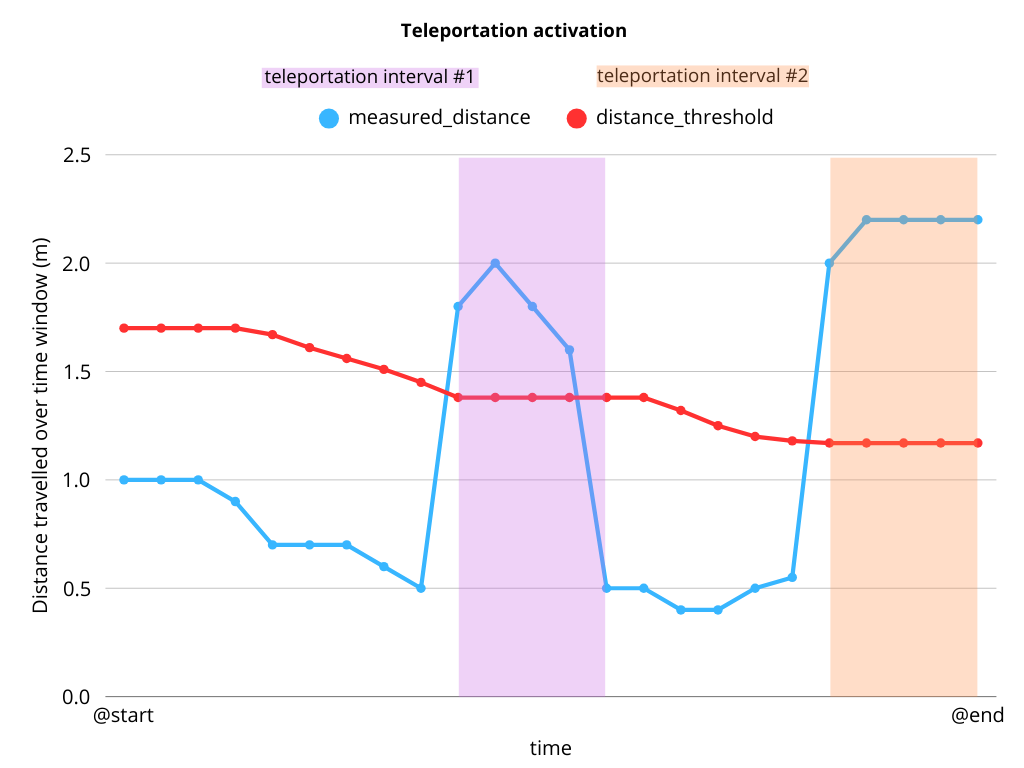
The interval ends when the object's traveled distance returns to its threshold or lower.
200.1 Plot
The following diagram illustrates how the Teleportation checker is triggered when the object's traveled distance exceeds its expected threshold, i.e., the object travels farther than expected. The interval ends only when the distance falls below the threshold.
200.2 Attributes
The following attributes define the behavior and characteristics of the evaluator.
| Checker attribute | Description |
|---|---|
| Parent object | vehicle.teleportation |
| Issue category | sut or other |
| Issue kind | teleportation |
| Default severity | warning |
| Trigger condition | Based on teleportation watcher |
| Operation modes | teleportation_checker |
200.3 Configuration parameters
The following parameters can be configured to customize the Teleportation evaluator's behavior.
| Parameter | Type | Unit | Description | Default Value | Range |
|---|---|---|---|---|---|
distance_factor_threshold |
float | Multiplier applied to the aggregated EMA distance to set the activation threshold. If the measured distance between consecutive samples exceeds the resulting value (plus tolerance), an interval is triggered. | 1.2 | [0.0, 10.0] | |
distance_threshold_tolerance |
length | m | Tolerance added to the distance threshold that determines whether an interval starts or ends. | 0.5m | [0.0, 50.0]m |
issue_severity |
enum (ignore, info, warning, error_continue, error, error_stop_now) |
Severity of the issue raised when teleportation is detected. | warning | ||
sample_clk_rate |
time | s | Checker sampling rate. | 0.1s | [0.0, 10]s |
smoothing_time |
time | s | Smoothing time constant for distance calculations. Larger values increase smoothing and slow response. See Exponential Moving Average (EMA) for how α is derived from sample_clk_rate and smoothing_time. |
0.4s | [0.0, 10]s |
enabled |
bool | Sets whether the checker is enabled in all scenarios by default. | true | ||
log_level |
enum (info_level, debug_level, trace_level) |
Level of information displayed on the console. | info_level |
200.4 Metrics
The following metrics are recorded and tracked by the evaluator.
| Metric | Type | Description | Range | Unit |
|---|---|---|---|---|
measured_speed |
speed | The measured speed at the moment the check was triggered | kph | |
measured_distance |
length | The measured distance traveled between the current and the previous time step | m | |
trigger_reason |
enum (distance_exceeded, no_reason) |
Indicates which condition triggered the checker | ||
interval_duration |
time | The duration of the checker's interval | s |
200.5 Log and Error messages
The following error message is generated with the severity determined by the ftlx_global_eval_config.
| Output Condition | Description | Default Severity | Action |
|---|---|---|---|
| Distance threshold is exceeded | Teleportation detected: Distance/speed exceeded thresholds | Warning | Investigate the object's behaviour. |
200.6 Usage
200.6.1 How to instantiate
The teleportation_checker can be instantiated for any physical_object.
checker teleportation_checker is teleportation(physical_object: actor) with:
        it.sut_issue(severity: ftlx_global_eval_config.ego_teleportation_checker_config.issue_severity,
                    kind: teleportation,
                    details: "Teleportation detected: $(teleportation_checker.data.trigger_reason.as(string).replace("_", " ")) threshold(s).")

keep(teleportation_checker.teleportation_checker_config == ftlx_global_eval_config.ego_teleportation_checker_config)
200.6.2 Set parameters at instantiation time
Bind the checker config with keep(...) in the declaration (see the instantiation example above).
200.6.3 Define and use a custom parameter set
Define a teleportation_checker_config struct to customize the checker's parameters:
const custom_teleportation_checker_config: teleportation_checker_config = new
set custom_teleportation_checker_config.distance_factor_threshold = 1.2
set custom_teleportation_checker_config.distance_threshold_tolerance = 0.5m
set custom_teleportation_checker_config.issue_severity = warning
set custom_teleportation_checker_config.sample_clk_rate = 100ms
set custom_teleportation_checker_config.smoothing_time = 0.4s
set custom_teleportation_checker_config.enabled = true
set custom_teleportation_checker_config.log_level = info_level
checker custom_teleportation_checker is teleportation(physical_object: actor)
keep(custom_teleportation_checker.teleportation_checker_config == custom_teleportation_checker_config)
200.6.4 Disabling the checker
To disable the checker, set the enabled flag to false in the teleportation_checker_config struct:
const teleportation_checker_config: teleportation_checker_config = new
set teleportation_checker_config.enabled = false
200.7 Additional information
All parameters are required, but you don't need to customize all of them.
For any parameter you don't customize with set, the default value defined in teleportation_checker_config is used.